FR | EN
FR EN
Complete guide

Choosing the right probiotic

Discover why Probaclac stands out and find the formula that fits your profile.
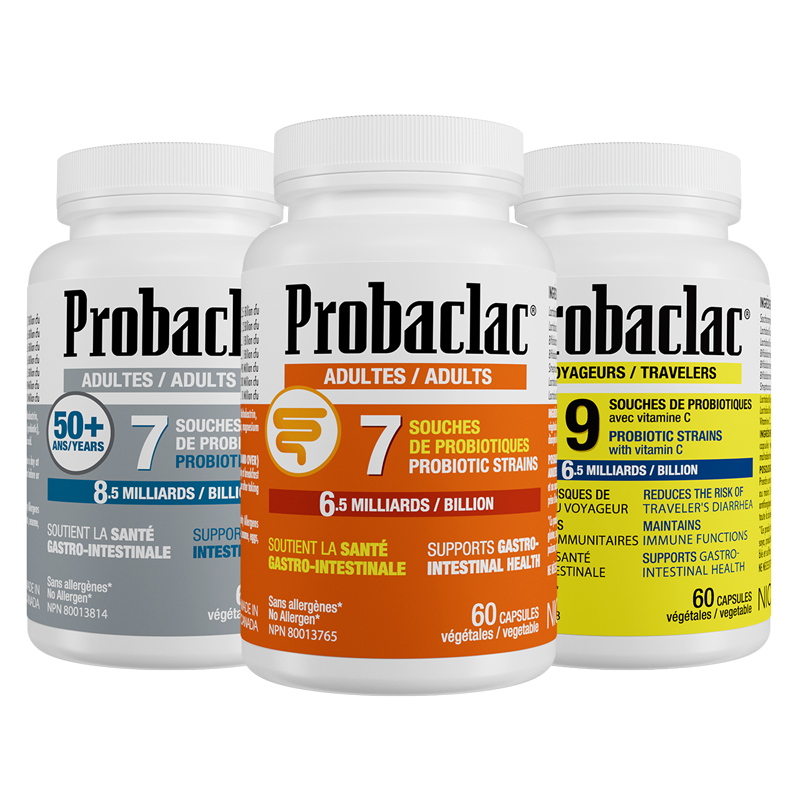
Probaclac product line - Adults 50+, Adults, Travelers

Why Probaclac?

NPN certified

All our products are NPN certified and approved by Health Canada.

Highest standards

Probaclac is manufactured to the highest standards and contains clinically tested probiotic strains.

Clinically tested

Probaclac undergoes rigorous quality control and is clinically tested to demonstrate the intended effects.

20 years of trust

Probaclac has been a trusted brand for over 20 years.

Formulas with prebiotics

Probaclac formulas with prebiotics, tailored to every age and condition.

Made in Quebec

Made in Quebec

The Probaclac line is proudly made in Quebec and approved by Produits du Québec.

Probaclac in your daily life

Discover all the benefits that probiotics bring to your health

Facilitating digestion 2,3,4,5,6,7,8,9,10,11,12

  • Bloating
  • Antibiotic-associated diarrhea
  • Constipation in older adults
  • Overseas travel

Preventing autoimmune reactions 13,20,21

  • Food allergies
  • Eczema

Protecting the heart 22,23

  • Dyslipidemia (blood cholesterol)
  • High blood pressure

Improving cognitive performance 25,26

  • Memory loss
  • Low mood

Regulating appetite and maintaining a healthy weight 1,15,32,33

  • Obesity or being overweight
  • Eating disorders
  • Type 2 diabetes

Supporting immunity 14,16,17,18,19

  • Respiratory infections
  • Urinary tract infections
  • Bacterial vaginosis
  • Ear infections
  • Vaccination in older adults

Reducing psychological stress 24,25,26,28,29

  • Anxiety
  • Depression
  • Difficulty concentrating

Delaying dermatological aging 34

  • Wrinkles
  • Dry skin
  • Scalp issues
  • Photosensitivity

Preventing inflammatory diseases 13,14

  • Crohn's disease
  • Irritable bowel syndrome

Preventing nutritional deficiencies 30,31

  • Autism spectrum disorders
  • Food intolerances

Slowing the progression of degenerative diseases 15

  • Alzheimer's disease
  • Parkinson's disease

Find your formula

Choose by age, condition or allergies

Probiotics and prebiotics

Probiotics

Probiotics are live micro-organisms that, when consumed in sufficient quantities, deliver positive health effects on the microbiota.

Multi-strain probiotics: A multi-strain probiotic covers the entire gastrointestinal tract.

Prebiotics

Prebiotics are plant fibres that we do not digest as they pass through the stomach. They serve as food for bifidobacteria.

Probaclac formulas contain prebiotics to nourish and support the good bacteria of your gut flora.

And what about probiotic yogurts?

Refrigerated probiotic yogurts pose several reliability challenges. The temperature chain, shelf life, and production conditions make it difficult to guarantee a sufficient number of live bacteria at the time of consumption.

Moreover, the production date of probiotic yogurts does not guarantee strain viability through the expiration date. Storage and transport conditions can compromise the effectiveness of the probiotics in these products.

Many probiotic yogurts also contain added sugar, which can reduce the effectiveness of probiotics. Excessive sugar content can compromise the viability and effectiveness of the strains.

Choose a probiotic that does not require refrigeration

Probaclac probiotics are formulated to remain stable at room temperature, which guarantees their effectiveness from manufacture through the expiration date, without depending on a fragile cold chain.

Probiotic yogurt

Allergen-free probiotics

Probaclac is proud to offer allergen-free probiotics*

Throughout the production of our probiotics, priority food allergens are avoided. We are committed to providing supplements suitable for everyone, regardless of sensitivity. Probaclac is the reference for probiotics without dairy proteins, gluten, soy and all classic allergens.


Gluten-free
Gluten-free
Soy-free
Soy-free
Lactose-free
Lactose-free
Vegetable capsules
Vegetable capsules

Why choose Probaclac?

  • Multi-strain
  • NPN certified
  • Clinically tested
  • Pharmaceutical grade
  • Specific formulations
  • Contains prebiotics
See our products →

đź“„ References

â–Ľ
1. Kadooka Y. et al. Effect of Lactobacillus gasseri SBT2055 in fermented milk on abdominal adiposity. European Journal of Clinical Nutrition. 2013.
2. McFarland LV. Meta-analysis of probiotics for the prevention of antibiotic associated diarrhea. World J Gastroenterol. 2006.
3. Surawicz CM. et al. Prevention of antibiotic-associated diarrhea by Saccharomyces boulardii. Gastroenterology. 1989.
4. Kotowska M. et al. Saccharomyces boulardii in the prevention of antibiotic-associated diarrhoea in children. Aliment Pharmacol Ther. 2005.
5. Hickson M. et al. Use of probiotic Lactobacillus preparation to prevent diarrhoea associated with antibiotics. BMJ. 2007.
6. Szajewska H. et al. Probiotics in the prevention of antibiotic-associated diarrhea in children. J Pediatr. 2006.
7. Can M. et al. Prophylactic Saccharomyces boulardii in the prevention of antibiotic-associated diarrhea. Med Sci Monit. 2006.
8. Cindoruk M. et al. Efficacy and safety of Saccharomyces boulardii in the 14-day triple anti-Helicobacter pylori therapy. J Clin Gastroenterol. 2007.
9. Duman DG. et al. Efficacy and safety of Saccharomyces boulardii in prevention of antibiotic-associated diarrhoea due to Helicobacter pylori eradication. Eur J Gastroenterol Hepatol. 2005.
10. Cremonini F. et al. Meta-analysis: the effect of probiotic administration on antibiotic-associated diarrhoea. Aliment Pharmacol Ther. 2002.
11. D'Souza AL. et al. Probiotics in prevention of antibiotic associated diarrhoea: meta-analysis. BMJ. 2002.
12. Sazawal S. et al. Efficacy of probiotics in prevention of acute diarrhoea: a meta-analysis. Lancet Infect Dis. 2006.
13. Isolauri E. et al. Probiotics: effects on immunity. Am J Clin Nutr. 2001.
14. Guarner F. et al. Gut flora in health and disease. Lancet. 2003.
15. Dinan TG. et al. The Microbiome-Gut-Brain Axis in Health and Disease. Gastroenterol Clin North Am. 2017.
16. Hao Q. et al. Probiotics for preventing acute upper respiratory tract infections. Cochrane Database Syst Rev. 2015.
17. Falagas ME. et al. Probiotics for the treatment of women with bacterial vaginosis. Clin Microbiol Infect. 2007.
18. Reid G. et al. Oral use of Lactobacillus rhamnosus GR-1 and L. fermentum RC-14 significantly alters vaginal flora. FEMS Immunol Med Microbiol. 2003.
19. Taipale T. et al. Bifidobacterium animalis subsp. lactis BB-12 in reducing the risk of infections in infancy. Br J Nutr. 2011.
20. Kalliomäki M. et al. Probiotics in primary prevention of atopic disease: a randomised placebo-controlled trial. Lancet. 2001.
21. Wickens K. et al. A differential effect of 2 probiotics in the prevention of eczema and atopy. J Allergy Clin Immunol. 2008.
22. Jones ML. et al. Cholesterol-lowering efficacy of a microencapsulated bile salt hydrolase-active Lactobacillus reuteri. Eur J Clin Nutr. 2012.
23. Khalesi S. et al. Effect of probiotics on blood pressure: a systematic review and meta-analysis. Hypertension. 2014.
24. Messaoudi M. et al. Assessment of psychotropic-like properties of a probiotic formulation. Br J Nutr. 2011.
25. Akbari E. et al. Effect of probiotic supplementation on cognitive function and metabolic status in Alzheimer's disease. Front Aging Neurosci. 2016.
26. Steenbergen L. et al. A randomized controlled trial to test the effect of multispecies probiotics on cognitive reactivity to sad mood. Brain Behav Immun. 2015.
28. Wallace CJK. et al. The effects of probiotics on depressive symptoms in humans: a systematic review. Ann Gen Psychiatry. 2017.
29. Liu RT. et al. Prebiotics and probiotics for depression and anxiety: A systematic review and meta-analysis. BMJ Nutr Prev Health. 2019.
30. Kang DW. et al. Microbiota Transfer Therapy alters gut ecosystem and improves gastrointestinal and autism symptoms. Microbiome. 2017.
31. Oak SJ. et al. The effects of probiotics in lactose intolerance: A systematic review. Crit Rev Food Sci Nutr. 2019.
32. Sanchez M. et al. Effect of Lactobacillus rhamnosus CGMCC1.3724 supplementation on weight loss and maintenance in obese men and women. Br J Nutr. 2014.
33. Cani PD. et al. Changes in gut microbiota control metabolic endotoxemia-induced inflammation in high-fat diet-induced obesity and diabetes in mice. Diabetes. 2008.
34. Kober MM. et al. The effect of probiotics on immune regulation, acne, and photoaging. Int J Womens Dermatol. 2015.